Do You Need an AI Visibility Tool, or Can You Just Check ChatGPT Yourself?
September 7, 2026
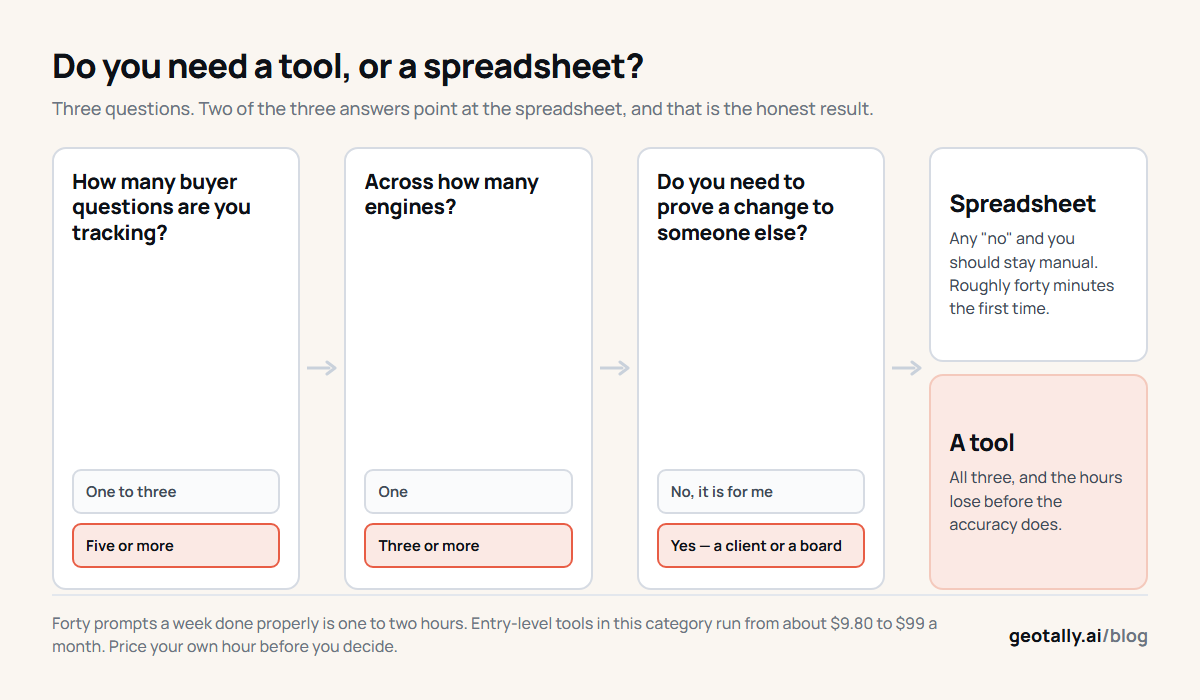
If you care about fewer than about five questions on one engine and you only need to know the answer once, check it yourself — the method is below and it costs nothing. You need a tool when you need a trend, several engines, or proof that something you published changed the answer.
We sell one of these tools, so read this with that in mind. It is also why the manual method below is the real one rather than a strawman. If checking by hand covers your situation, do that.
Check it yourself, properly
Most people do this wrong in the same three ways: they type their brand name, they use their own logged-in account, and they ask once. Here is the version that produces something you can trust.
1. Ask the question a buyer asks, not the one you wish they'd ask. Never name your brand. Engines will describe anything you name — ask "is Acme good?" and you will get a paragraph about Acme, which tells you nothing about whether Acme gets recommended. Ask "what's the best CRM for a small law firm?" instead. The whole test is whether you come up unprompted.
2. Use a clean session. Log out, or open a temporary chat with memory and personalisation off. ChatGPT remembers you. If you have discussed your own company with it, you are testing your history, not the model.
3. Ask five questions, not one. Pick the five your sales calls keep repeating. That is your buying-question set, and it is the same set a tool would run.
4. Ask each one twice, on different days. This is the step everyone skips and it matters more than the rest. These answers are not stable. The same question, asked twice, can return a different set of brands. When we built our own weekly category leaderboards we had to run every prompt twice for exactly this reason — one answer is an anecdote.
5. Log it in a spreadsheet. Columns: date, question, engine, were you named, were you cited with a link, which competitors appeared, how you were described. That last column is the one people leave out and later wish they had, because "a solid budget option" and "a leading choice" both count as a mention.
6. Repeat next month and compare.
That is a real method. It takes maybe forty minutes the first time. Do it before you buy anything from anyone, including us.
When checking by hand is the right answer
Three situations where a subscription would be waste.
You have one question that matters. A single category, a single phrasing, one engine. Check it monthly and get on with your day.
You are doing a one-off audit. You want to know where you stand before a rebrand, a raise, or a strategy session. That is a snapshot, not a monitoring problem. Do it by hand, or run a free check and be done.
You have no intention of changing anything. If nobody on the team is going to write, pitch or fix anything in response to the number, the number is trivia. A tool measures work you are actually doing. Without the work, it is a dashboard nobody opens.
When it breaks
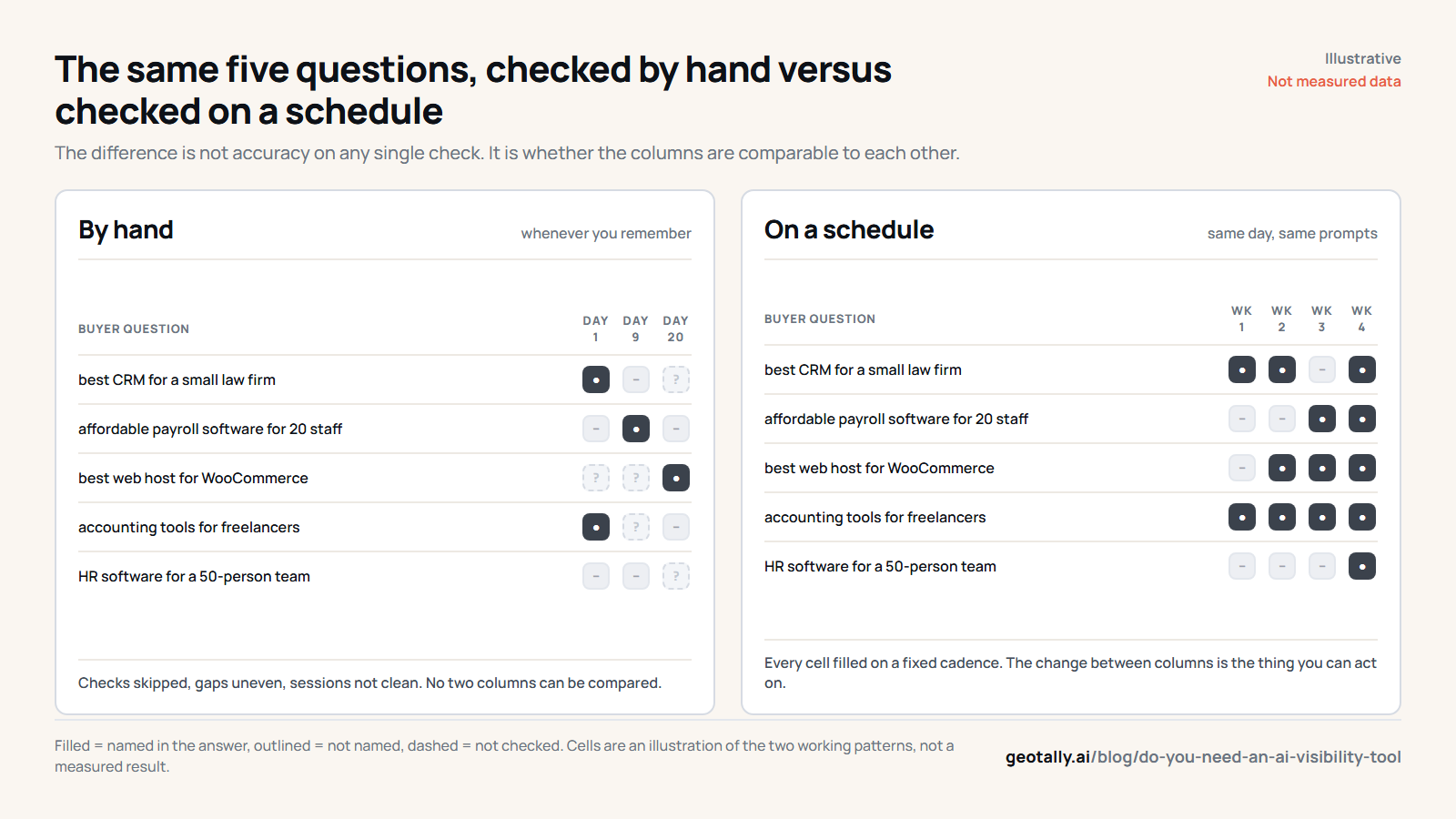
Four things go wrong with the spreadsheet, in roughly this order.
Variance eats your afternoon. Because answers drift, one check is not a reading. To see a real change you need the same questions asked repeatedly on a fixed cadence, which multiplies the work by however many repeats you decided you needed. Five questions × two repeats × four engines is forty prompts a week. That is not a spreadsheet task any more, it is a job.
Your buyers are not all on ChatGPT. They are also asking Gemini, Perplexity, Claude and Microsoft Copilot, and Google is writing an AI Overview above the ten blue links whether anyone asks it to or not. Each engine has its own answer and its own set of favoured brands. Checking one and assuming the rest is like checking your Google rankings and assuming Bing.
You cannot prove causation. You publish a comparison page in March. In May, ChatGPT starts naming you. Did the page do it? Without a baseline recorded before you published, and consistent checks after, you have a feeling rather than a finding. If you are reporting to a client or a board, a feeling does not survive the first hard question.
You stop. This is the honest one. Manual tracking has a half-life of about six weeks. The first month is diligent, the second is patchy, and by the third the spreadsheet has a gap where the interesting change happened. Automation's real value is not speed — it is that it keeps going after you have lost interest.
The arithmetic, without the sales pitch
Forty prompts a week, done properly in clean sessions and logged, is somewhere between one and two hours. Call it six hours a month. Price your own hour honestly.
Entry-level tools in this category run from about $9.80 to $99 a month depending on engine coverage and how usage is metered — we listed every published price in what AI visibility tracking costs. Geotally's own entry plan is $19/month for five prompts across all six engines, weekly.
So the question is not really "tool or no tool". It is whether six hours a month of your attention is worth less or more than the subscription. For a solo founder with three questions and no client to report to, hands down do it yourself. For anyone tracking a category, reporting to someone else, or actively publishing to close gaps, the spreadsheet loses on hours before it loses on accuracy.
A middle option most people miss
You do not have to choose today.
Run a free check to find out whether you have a gap at all. If AI answers already name you in most of your buying questions, you have a smaller problem than you thought and can go back to your other work. If they name you in none of them — which is the more common result — you now know the size of the thing, and you can decide whether it is worth $19 or six hours.
We ran our own tool on ourselves for the same reason. The first time we asked ChatGPT the buying questions for "AI visibility tracking tools" without naming ourselves, Geotally was named in 0 of 3 answers. We published that. It is an uncomfortable number and it is also the entire argument: you cannot fix what you have not measured, and a measuring instrument that only ever reports good news is not one.
Run the free check on your brand — three real buying questions through ChatGPT, no account, no card, about a minute.
FAQ
Can I check my brand in ChatGPT for free? Yes. Log out or turn off memory, ask a buying question without naming your brand, and note whether you appear. Repeat on a second day. Geotally's free check does the same thing across three questions and returns the count.
How often should I check? Weekly is enough to see movement without drowning in noise. Monthly works if you are not actively publishing. Daily only earns its keep when you have shipped a change and want to watch it land.
Why do I get a different answer every time I ask? Because these are generated responses, not rankings. Phrasing, session history, region and the day all move the result. That is why any serious measurement repeats the same prompt rather than trusting one answer.
Does asking ChatGPT about my own brand help my visibility? No. Asking about yourself does not train the model or influence anyone else's answer, and naming your brand in the prompt guarantees a response about it — which is the fastest way to fool yourself into thinking you are visible.
Do I need a tool that covers every engine? Only the engines your buyers use. If your market is entirely on ChatGPT, a cheap single-engine tool or a spreadsheet is fine. If Google AI Overviews decide your category, that is a different shopping list — see the 12 best Google AI Overview trackers.
What do I do with the number once I have it? The work is content and third-party coverage: publish direct answers to the questions you are missing, and earn mentions on the pages the engines read. Then re-measure. What is a GEO tracker? covers the loop.
Related: What AEO means · How to track Google AI Overviews · Compare Geotally side by side
Geotally team · Last reviewed September 2026